
The Greater Vancouver Regional Research Project
We are grateful to the people of the kʷikʷəƛ̓əm, qiqéyt, xʷməθkʷəy̓əm, səlilwətaɬ, Sḵwx̱wú7mesh Úxwumixw, sc̓əwaθən məsteyəxʷ, q̓ic̓əy̓, qʼʷa:n̓ƛʼən̓, and Semiahmoo Nations. Thank you for the opportunity to do this project on the beautiful lands you have stewarded, cared for, and advocated to protect for generations immemorial.
The Greater Vancouver Regional Research Project (GVRRP) is a community-led research initiative coordinated by Homelessness Services Association (HSABC).
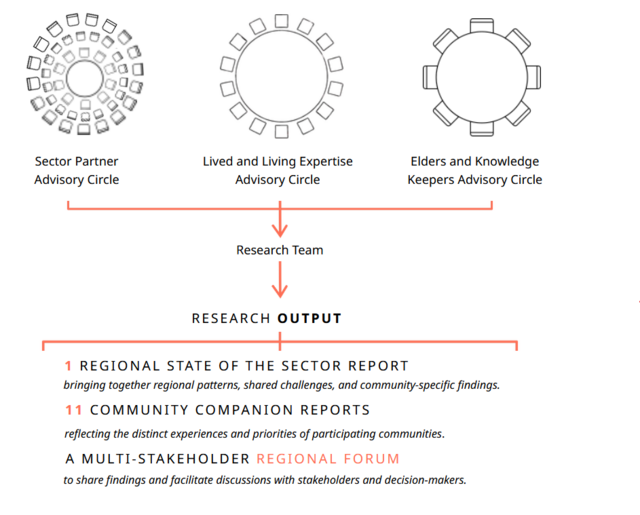
Weaving together the perspectives of diverse stakeholders, this project will result in a rich multifaceted understanding of the state of the sector across 11 different Greater Vancouver communities on the lands of 9 First Nations. The research findings will be presented in eleven Community Companion Reports and an overarching Regional Report. These documents will reflect the experiences of people from each community as well as action-oriented recommendations that emerge from patterns across different experiences.
Project Scope
- Assess the current state of the homelessness sector across the region through an environmental scan of services, programs, partnerships, and system structures.
- Understand barriers that people experiencing homelessness encounter when trying to access needed supports or services.
- Identify strengths, service gaps, operational challenges, and opportunities for improved coordination from the perspectives of frontline staff,organizational leaders, and people with lived and living experience.
- Develop practical recommendations for promising practices, system improvements, and policy changes to strengthen the regional homeless response.
Two Connected Levels of Analysis
Regional level:
The Regional State of the Sector Report will provide a bird’s eye view of all communities included in the region, integrating community-level data as well as what we learn from:
- Elders and Knowledge Keepers
- Sector Partners
- Lived and Living Expertise Advisory Circle
- Engagement with services providing services to specific populations facing unique challenges
Community level:
Participating Greater Vancouver communities will be respected as distinctive communities, with its own service landscape, relationships, strengths, and challenges. Community Companion Reports will draw on engagement with:
- Local homelessness coalitions, task groups, and community tables.
- Service providers - leadership and front-line staff.
- People with lived and living experience who have navigated local services.
Participating Communities
Burnaby
Delta
Langley (City and Township of Langley)
New Westminster
North Shore (N/W Vancouver)
Richmond
Ridge Meadows (Maple Ridge and Pitt Meadows)
Surrey
Tri-Cities (Port Coquitlam, Port Moody, Coquitlam)
Vancouver
White Rock
Research Methods
The study combines qualitative engagement with a review of existing research, plans, policies, service models, and available quantitative research.
- Qualitative engagement through focus groups discussions with:
- People with lived and living experience who have accessed or tried to access local services.
- Frontline staff working in shelters, drop-in spaces, outreach, or related homelessness services.
- Leadership from organizations providing homelessness-related services.
- Document review and environmental scan of existing plans, policies, and service models across the region. This process will be informed by existing quantitative research and informed by community knowledge and consultation with local coalitions, task groups, and other stakeholders.
Our Commitment to Ethical Research
This project prioritizes informed consent, participant choice, respect, and confidentiality. Engagement will be designed to be trauma-informed and culturally safe, with attention to power, accessibility, and the different circumstances people bring to research.
Indigenous engagement and data governance will be guided in partnership with Indigenous partners, including consideration of CARE and FAIR frameworks. Local protocols and guidance will shape engagement, and no single approach will be assumed to represent all Nations or communities.
We approach this work with humility, reciprocity, and respect for the knowledge and relationships that communities contribute.
Advisory Circles
The research is overseen by three Advisory Circles to ensure the project is grounded in the perspectives of important stakeholders at every stage. The Advisory Circles gather quarterly for updates on research activities and to provide critical guidance throughout the project’s lifespan.
How to get involved
If you have any questions and/or would like to participate in a focus group, please reach out to our research team: gvrproject@hsa-bc.ca